
Need Help? Chat with us

Saturday - Wednesday: 9 AM - 10 PM
Thursday: 9 AM - 9 PM
Friday: Closed

October 24, 2026
What Are Dental Sealants and How Do They Prevent Cavities?
Dental sealants are thin protective coatings placed on the chewing surfaces of the back teeth. They cover the deep grooves where food and plaque like to settle, which helps lower the risk of cavities in spots a toothbrush struggles to reach.
Children and teenagers are the most common candidates, because their new molars are especially prone to decay. Some adults may benefit too, particularly if they have deep grooves and no existing damage. Sealants work alongside brushing, flossing and regular check-ups. They do not replace any of them.
What Are Dental Sealants?
Sealants are made from a thin plastic-based material, usually a clear or tooth-coloured resin, though some dentists use a glass ionomer material. It is applied as a liquid that quickly hardens into a smooth, protective layer. They are most often placed on molars and premolars, the broad back teeth that do most of the chewing.
These teeth have natural pits and grooves that can be narrower than a single toothbrush bristle, so plaque and leftover food hide in them easily. A sealant fills those grooves and acts as a physical barrier against decay. It differs from a filling, which repairs a tooth after decay has already made a hole. A sealant sits on top as prevention and usually needs little or no drilling.
What Are the Benefits of Dental Sealants?
Sealants offer a simple, gentle way to protect teeth that are at higher risk. The benefits of dental sealants are mostly about stopping problems before they begin.
Here are the main ways they help.
Help Prevent Cavities in Back Teeth
Back teeth are where most childhood cavities start. A Cochrane review found that permanent molars sealed in children aged 5 to 10 had more than 50% less decay on their chewing surfaces after about four and a half years, compared with unsealed teeth. Sealing does not make a tooth immune, but it clearly lowers the odds.
Protect Hard-to-Clean Areas
Even careful brushers miss the bottom of a deep groove. Children, who are still learning to brush well, find it harder still. A sealant smooths that surface out, so there is less place for plaque to hide, and the tooth becomes much easier to keep clean.
Support Preventive, Minimally Invasive Care
Placing a sealant is quick and usually requires no injection or drilling. It protects the natural tooth, which can help avoid larger treatments later. For anxious children, and for adults who dislike dental work, that gentle approach is a real advantage.
What Happens During the Dental Sealant Procedure?
The dental sealant procedure is quick, comfortable and usually finished in a single visit. Most people feel no pain at all.
Here is what to expect, step by step.
Step 1 — Cleaning the Tooth
Your dentist first cleans the tooth surface with a small brush or polishing tool. This removes plaque and food debris from the grooves so the sealant can bond properly to clean enamel.
Step 2 — Preparing and Drying the Surface
The tooth is then rinsed and kept dry using small cotton rolls or similar. A mild solution may be applied to the surface for a short while to help the sealant grip. Dryness matters here, because moisture can stop the material from sticking well.
Step 3 — Applying the Sealant
The liquid sealant is painted carefully onto the chewing surface, flowing into the pits and grooves. It only takes a few moments per tooth, and nothing about it should feel uncomfortable.
Step 4 — Setting and Checking the Sealant
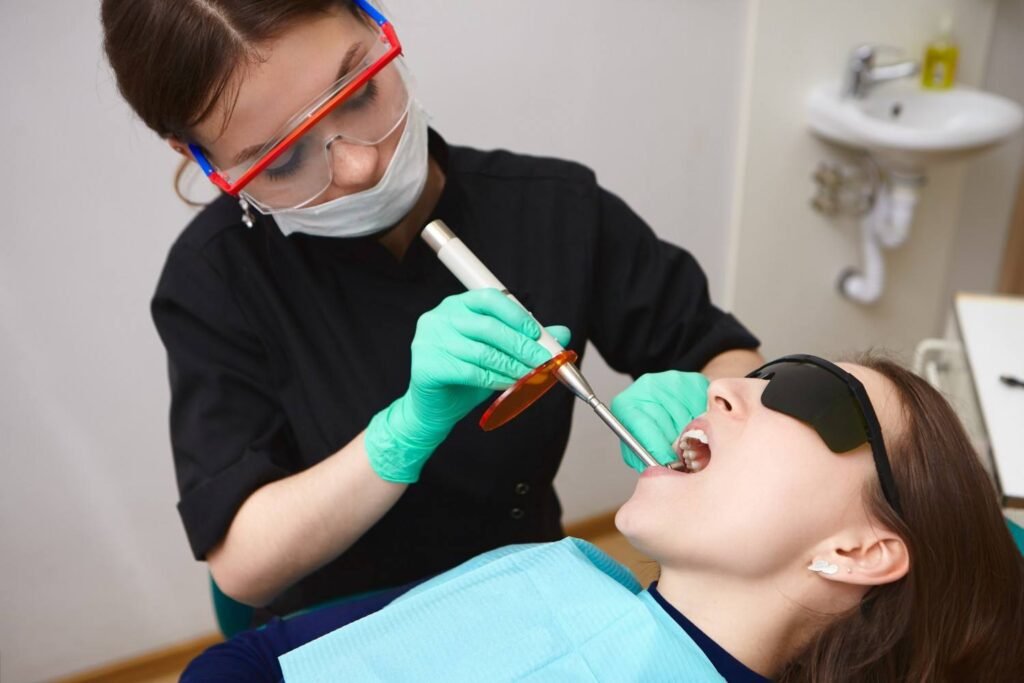
A special curing light is used to harden the sealant within seconds. Your dentist then checks that it has covered the grooves fully and that your bite feels normal. If anything feels high or uneven, a quick adjustment is made.
Are Dental Sealants Safe, and Are There Any Limitations?
Sealants have been used in dentistry for decades and are generally well tolerated. A clinical guideline from the American Dental Association and the American Academy of Pediatric Dentistry reviewed their effectiveness, how well they stay in place and possible side effects, and supports their use in children and teenagers. It also found that sealing early, non-cavitated spots can help slow decay from progressing.
Still, sealants have limits. They only protect the surface they cover, so decay between teeth or along the gumline is not prevented. They can chip or wear down, and they are not suitable for every tooth, especially if decay is already deep. Your dentist will assess whether they make sense for you.
How Long Do Dental Sealants Last?
With good care, sealants can last for several years, though no one can promise an exact time. How long they stay in place depends on how well the tooth was prepared, your bite and your habits. Chewing ice, hard sweets or very sticky foods can wear them down faster.
That is why they are checked at regular dental visits. If a sealant has worn thin or come off, it can be repaired or replaced, and the tooth is protected again. There is no fixed replacement schedule. Your dentist will look at each one and advise on what is needed.
What Should You Do After Getting Dental Sealants?
You can usually eat soon after the visit, but it is sensible to follow your dentist’s advice about timing. Avoid biting down on hard objects, ice or very sticky sweets, and carry on with brushing twice a day with fluoride toothpaste and cleaning between your teeth. Keep your regular check-ups, so the sealants can be examined and repaired if needed. If a sealant feels rough or comes loose, let your dentist know.
Conclusion
Sealants are a quiet, preventive step that can protect the teeth most likely to develop cavities. They are not a substitute for good habits at home, but they give your daily brushing some very useful backup, especially in children and teenagers.
If you are wondering whether dental sealants suit your child, the team at Diamond Dentals in Kuwait can examine your teeth and advise honestly. Sometimes sealants are a good idea, and sometimes other care is a better fit.
FAQs
- Do dental sealants hurt?
No, the procedure is painless for most people and does not usually need an injection or drilling. You may just feel the dentist’s tools and a slightly dry tooth. - Can adults get dental sealants?
Yes, adults with deep grooves and no decay in their back teeth may benefit. Your dentist will check whether it makes sense for you. - How effective are dental sealants?
Research shows they considerably reduce cavities on the chewing surfaces they cover. They only protect the teeth they are placed on, so brushing still matters. - Can dental sealants be applied to teeth with cavities?
Not to teeth with established cavities, which need a filling. Very early, shallow spots may sometimes be sealed, but only after your dentist assesses them. - Do dental sealants replace fluoride toothpaste?
No, they protect different things. Sealants cover the chewing surfaces, while fluoride strengthens enamel across the whole tooth. - How often should dental sealants be replaced?
There is no set schedule, because it depends on wear. Your dentist checks them at regular visits and repairs or replaces them if needed.
Search
Recent Posts
-

-

Dry Mouth: Common Causes, Symptoms and Treatment Options
24, Oct, 2026
-

-

What Causes Bad Breath and How Can You Get Rid of It?
23, Oct, 2026
-

Top 10 Benefits of Dental Implants
19, Aug, 2025
Looking for professionals & trusted medical healthcare?
Don't hesitate to contact us.

Contact Us
Get In Touch With Us




HyperText Markup Language (HTML) is the standard markup language for creating web pages and web applications.
© 2024 All Right Reserved